The AI Control Gap in Regulated Industries
Every Head of Risk is being asked to do two things at once: help the organisation move faster on AI, and prove the organisation still has control of it.
That tension is becoming harder to manage.
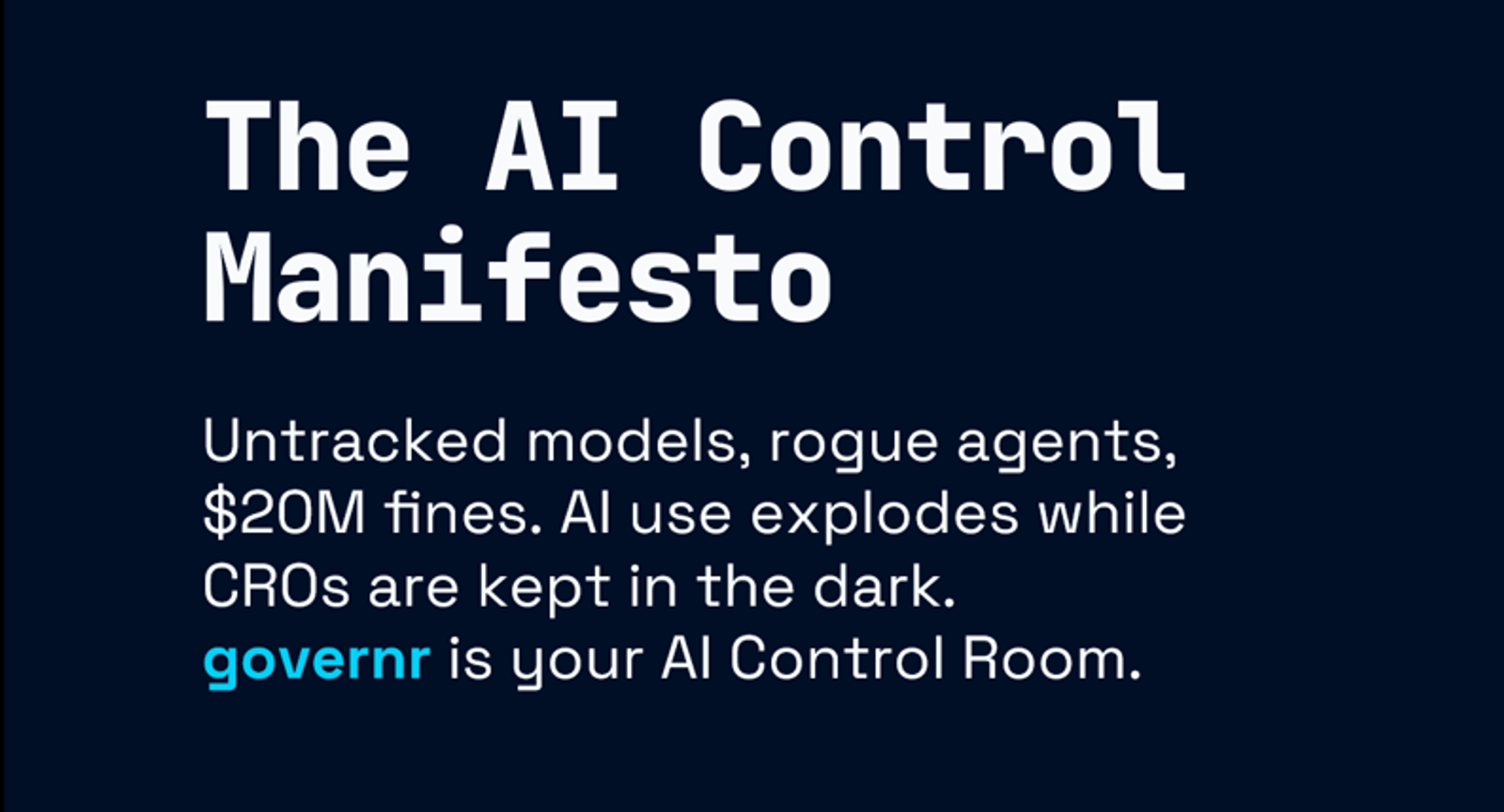
AI is not entering regulated firms through a single door. It is spreading through approved copilots, embedded vendor features, internal models, APIs, workflow automations, and increasingly, agents. What makes this dangerous is not simply adoption. It is the fact that most firms do not have a reliable way to see what is live, who owns it, what data it touches, how it has changed, or whether it is operating inside policy. That is the core control gap described in governr’s latest publication, The AI Control Manifesto.
Download the Manifesto
For risk leaders in banking, healthcare, and defence, this is no longer a future-state governance issue. It is an operating reality.
The report argues that AI proliferation is now inevitable and accelerating, while manual oversight models are breaking under the volume and velocity of change. It points to a world where models, agents, and APIs are multiplying across business functions, while quarterly reviews, static inventories, and spreadsheet-based governance remain the norm.
That mismatch is where exposure grows.
Why the old model no longer works
Most existing risk and compliance structures were not built for AI that updates continuously, relies on external providers, and appears inside ordinary business tools without a formal implementation project.
The report makes a blunt point: manual governance collapses beyond hundreds of assets. It also argues that senior executives are increasingly accountable for proving enterprise-wide AI control, with expectations moving toward live traceability, not retrospective reassurance.
That should resonate with any risk leader who has already been asked questions like:
- What AI assets are currently in use across the firm?
- Which of them are high risk?
- Who owns them?
- What data do they access?
- What has changed in the last 30 days?
- Could we produce evidence quickly for the board or a regulator?
In many firms, those questions still trigger a manual exercise. That is the problem.
AI risk management cannot depend on scattered documentation, delayed attestations, and partial visibility. In regulated industries, that is not just inefficient. It is structurally weak.
The issue is not AI adoption. It is lack of control
Too many conversations still frame this as an AI governance challenge in the abstract.
It is more specific than that.
The real issue is that most firms do not yet have a control layer for AI. They may have policies. They may have committees. They may even have model risk processes. But those are not the same as operational control.
The report introduces the idea of an AI Control Room: a live control layer designed to help firms move from fragmented oversight to continuous visibility, control, and proof. It outlines five core components:
- a policy engine
- a universal asset registry
- a risk quantification engine
- live controls and guardrails
- proof generation
That framing is important because it shifts the conversation away from vague governance ambition and toward concrete operating capability.
Risk leaders do not need another high-level AI principles deck. They need a way to answer basic but critical questions on demand, across internal AI, third-party AI, and shadow AI.
What this means for banking, healthcare, and defence
The industries feeling this pressure most intensely are the ones where accountability, resilience, and auditability matter most.
In banking, the challenge is not just model risk in the traditional sense. It is the spread of AI into customer interactions, fraud workflows, operations, trading support, and vendor ecosystems, often faster than second-line functions can track. The report highlights the growing expectation for live oversight and evidence rather than periodic review.
In healthcare, the stakes are different but just as serious. AI can influence decisions, touch sensitive data, and move across clinical, operational, and vendor-managed environments. Risk leaders need to know what is deployed, what is connected, and where oversight stops being reliable.
In defence and other security-sensitive sectors, the problem expands again. Here, unknown dependencies, untracked agents, and uncontrolled external AI services are not just compliance concerns. They are operational and strategic risks.
Across all three sectors, the pattern is similar: AI is spreading faster than traditional control structures can keep up.
What good looks like
One of the more useful parts of the report is that it does not stop at the problem. It outlines what mature AI control should look like in practice.
According to the report, a strong future-state environment includes:
- a Chief Risk Officer view where AI assets are categorised by risk tier and issues are visible in real time
- board reporting that shows concentrations, dependencies, and worst-case exposure without manual assembly
- regulatory exam readiness with evidence tied back to source data
- incident response workflows that contain digital worker failures quickly
- shadow AI discovery that turns unknown assets into governed assets in days rather than months
That is a far more useful benchmark than generic claims about responsible AI.
It gives risk leaders a way to think about maturity in operational terms:
Can we see it? Can we assess it? Can we control it? Can we prove it?
Why this report is worth reading
There is no shortage of AI content right now. Most of it either celebrates adoption or warns about risk in broad terms.
This report is more valuable because it names the control problem directly.
It is built for leaders who already know AI matters and are less interested in theory than in the practical implications for enterprise risk, board accountability, regulatory readiness, and operating model design. It makes a strong case that the next phase of AI risk management will be defined not by policy documents alone, but by whether firms can build continuous visibility and control into the way AI actually operates.
For Heads of Risk, that is the conversation that matters now.
If your organisation is pushing further into AI while still relying on partial inventories, manual reviews, or fragmented ownership, this report will likely feel familiar.
And that is exactly why it is worth reading.
Read the report
Download The AI Control Manifesto to see how governr is framing the control challenge for regulated firms, and what an actual AI control model could look like in practice.
Ready to take control of your AI risk?
Get in touch to see how governr can help you inventory, assess, and monitor all your AI systems.