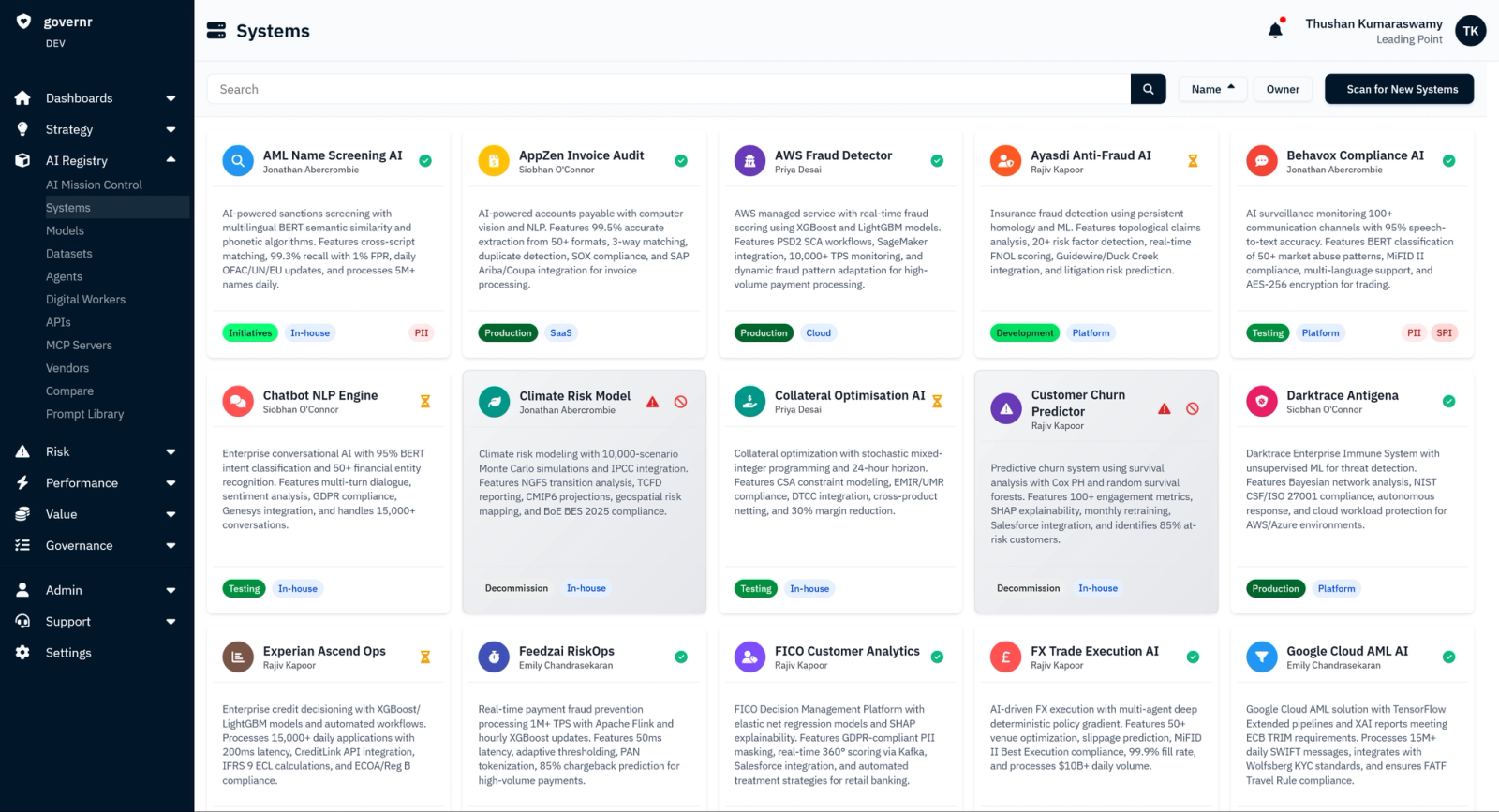
You Can’t Govern What You Can’t See: The AI Inventory Crisis
What AI is actually live inside your organisation today?
That is the first question every board, regulator, and risk leader should be asking. It is also the question most organisations still cannot answer cleanly.
They can usually name the approved pilot. The official chatbot. The internal assistant that made it through governance. What they often cannot name is the much larger estate around it: vendor tools that quietly introduced generative AI, copilots turned on inside existing software, internal automations built by business teams, developer-adopted AI services, and agents connected to systems, data, and permissions that nobody revisited after launch.
That is the real AI inventory crisis. The first failure in enterprise AI governance is not policy. It is visibility.
AI governance starts with an AI inventory
Before an organisation can manage AI risk, classify high-risk AI systems, assess third-party AI exposure, or provide board-level assurance, it needs a live view of what AI exists in the enterprise.
That means more than a static list of approved tools.
A credible enterprise AI inventory should answer:
- what AI systems are live
- where they are used
- who owns them
- what data they touch
- what actions they can influence or take
- whether the system is internal, third-party, embedded, or agentic
- what changed, and when
Without that, AI governance becomes a theoretical exercise. You cannot assign accountability to systems you cannot identify. You cannot classify risk for use cases you do not know exist. You cannot evidence oversight to regulators if your inventory is partial or stale. You cannot brief the board credibly if the answer depends on a spreadsheet updated last quarter.
That is why AI asset inventory is no longer administrative hygiene. It is the control layer underneath everything else.
Why most AI estates are larger than leadership realises
Many executive teams still think about AI as a set of visible projects. That view is already outdated.
In practice, AI is spreading through organisations via multiple channels at once:
1. Internal experimentation and shadow AI
Employees use AI-enabled tools to move faster, often without thinking of themselves as deploying AI at all. They summarise documents, generate content, analyse data, and automate tasks through services that may never pass through a formal approval path.
2. Developer-led adoption
Engineering teams test APIs, connect models, deploy assistants, and experiment with workflows well ahead of central governance. This is often where AI capability expands fastest.
3. Third-party embedded AI
Existing vendors add copilots, automation, classification, summarisation, or decision support into products you already bought. The contract may not have changed. The risk profile has.
4. Agentic AI and connectors
Agents can retrieve data, call tools, escalate actions, and operate across enterprise systems. Once connectors and permissions are added, the operational risk surface changes materially.
Most firms are not dealing with one AI programme. They are dealing with an AI estate that is distributed, dynamic, and increasingly difficult to see through manual process alone.
Why static inventories fail
A lot of organisations still treat AI discovery like a periodic compliance exercise. They circulate a survey. Ask teams what they use. Consolidate the responses. Review them in committee. Produce a register.
Then reality moves.
- A vendor ships a new feature.
- A team changes models.
- A workflow expands scope.
- An agent gets access to another system.
- A product team activates a capability no one reclassified.
- A pilot becomes operational but never gets updated in the register.
The inventory starts ageing the moment it is completed.
That is the structural problem. AI systems change continuously, but most control environments still rely on point-in-time discovery. A static inventory in a dynamic environment is just delayed blindness.
The board and regulator problem
The reason this matters so much in 2026 is that boards and regulators are no longer satisfied with broad assurances that “we have AI governance in place.”
They want clearer answers: What AI is live right now? Which use cases are higher risk? Where is third-party AI embedded? Who owns it? What changed recently? What evidence can the organisation produce on demand?
If management cannot answer those questions, the board is not overseeing AI from a position of control. It is overseeing a moving target with incomplete visibility. That is not a governance gap in theory. It is a governance gap in practice.
The three blind spots most firms underestimate
Employee-level AI use
This is where shadow AI grows fastest. Teams adopt AI-enabled tools in the flow of work long before central controls know what is happening.
Vendor change after procurement
Third-party AI risk does not stop at onboarding. Vendors add features, switch models, alter retention, and expand capabilities after the initial review. A questionnaire completed once tells you very little about what is live later.
Agentic expansion
Agents do not just generate outputs. They can trigger actions, call tools, access systems, and create side effects. That means a small permission change can materially increase enterprise exposure.
What a modern AI inventory needs to become
An AI inventory platform or AI control layer should not function like a spreadsheet. It should operate like living infrastructure.
That means:
- continuous discovery, not annual declaration
- ownership mapping, not anonymous tool use
- risk classification by context
- tracking of internal and third-party AI
- detection of vendor change and permission drift
- linkage to controls, issues, and reporting
- evidence that is usable for audit, board review, and regulation
In other words, the inventory should not just describe the estate. It should support governance across it.
The firms that get this right will move faster
There is a temptation to treat AI inventory as a defensive task. In practice, it does much more than reduce risk. The firms with the clearest visibility into their AI estate can approve use cases faster, monitor third-party AI more credibly, answer board questions more directly, and scale adoption with less internal friction. That is why this is not a side issue.
AI inventory is now the foundation of enterprise AI governance.
Before you can govern AI responsibly, monitor AI risk, manage third-party AI, or prove regulatory readiness, you have to see what is live.
Most firms are still earlier in that journey than they admit. And that is exactly why the inventory crisis matters now.
Ready to take control of your AI risk?
Get in touch to see how governr can help you inventory, assess, and monitor all your AI systems.