Why AI Is Not Just Another Technology Risk
One of the quietest mistakes in enterprise AI governance is also one of the most dangerous: treating AI like just another technology risk.
It sounds sensible at first. Firms already have frameworks for software, infrastructure, vendors, cyber, privacy, and operational resilience. So when AI arrives, the instinct is to slot it into those existing lanes and move on.
That instinct is understandable.
It is also a mistake.
AI is not just another software category. It behaves differently, changes differently, depends on different things, and creates a different control problem. When firms try to govern it using only the language and assumptions of traditional technology risk, they usually miss the very characteristics that make AI harder to control.
That is where false confidence starts.
Why firms default to this view
Most organisations do not want to create an entirely new control category unless they have to.
It is easier to say AI is simply another application type, another vendor risk, another technology change, or another digital transformation initiative. That keeps governance familiar. It avoids organisational friction. It lets teams reuse existing review forums and approval processes.
In the short term, that feels efficient.
In practice, it often reduces AI governance to a combination of policy statements, one-time reviews, and general technology controls that were not designed for systems that generate variable outputs, rely on upstream model changes, or operate with increasing autonomy.
The problem is not that those controls are useless. Many still matter. The problem is that they are incomplete.
What makes traditional technology risk different
Traditional software is usually more bounded than AI.
Even complex systems tend to do what they were built to do unless something breaks. Their behaviour is relatively stable. Their logic can usually be traced. Their outputs are more predictable. Their permissions and functions are easier to define in advance. Their change processes are often tied to code releases, infrastructure updates, or vendor-managed upgrades that fit reasonably well into existing IT governance.
That does not mean traditional software is low-risk.
It means the control model is better understood.
When a regulator, auditor, or board asks what a traditional system does, the organisation can usually explain it with a degree of confidence. It may be complicated, but it is still largely deterministic.
AI changes that equation.
What makes AI materially different
AI systems are not just software with a better interface. They introduce characteristics that are materially different from the systems firms are used to governing.
First, they are often probabilistic rather than deterministic. The same system can produce different outputs depending on prompt design, context, data, model configuration, or upstream change.
Second, many AI systems depend on factors the firm does not fully control. Third-party models, vendor features, API dependencies, retrieval pipelines, plugins, and orchestration layers can all affect behaviour in ways that are not obvious from the front end.
Third, AI systems increasingly influence judgement and action rather than simply processing rules. Even where they do not make final decisions, they shape recommendations, rankings, summaries, next steps, and operational responses. That influence matters, especially in regulated environments.
Fourth, AI systems do not always stay within the scope originally imagined for them. A summarisation tool becomes a drafting tool. A drafting tool becomes a customer-facing assistant. A read-only agent becomes an action-taking agent. An internal workflow becomes connected to a live system. Over time, the control perimeter shifts.
And fifth, AI often becomes harder to explain after the fact than firms expect. When something goes wrong, it is not always enough to ask what code ran. The real questions may involve prompts, context, data, model versions, access permissions, orchestration logic, or upstream vendor behaviour.
That is a very different control problem from ordinary software risk.
Why traditional control patterns break down
This is where many firms run into trouble.
They assume that existing technology governance will catch the risk. But many of the standard control patterns are too static for how AI actually behaves.
Annual or quarterly review cycles are often too slow for systems that can materially change in between review points.
Standard system inventories may miss embedded AI features inside approved platforms.
Traditional software approval processes often focus on procurement, security, or architecture, but not on behavioural risk, autonomy, or evidence quality.
Access reviews may tell you who can log in, but not how far an agent can act once connected to tools or workflows.
Change management may track code deployments but not prompt logic, model updates, vendor changes, or expanded use cases.
The result is a common but dangerous state: the organisation believes the system is governed because it has passed through familiar processes, while the actual sources of AI exposure remain only partially understood.
That is not control. It is administrative comfort.
What better AI control looks like
The answer is not to throw away every existing control framework.
The answer is to recognise where AI requires something more.
That means starting with visibility. Firms need to know what AI is live, where it sits, who owns it, and what it connects to.
It means classification. Not every AI use case carries the same level of exposure, and not every system deserves the same level of control.
It means evidence-based assessment. Firms need to understand not just that an AI system exists, but how it behaves, what it depends on, what it touches, and where it could fail.
It means mapping those risks into legal, regulatory, operational, and governance obligations that the rest of the organisation can understand.
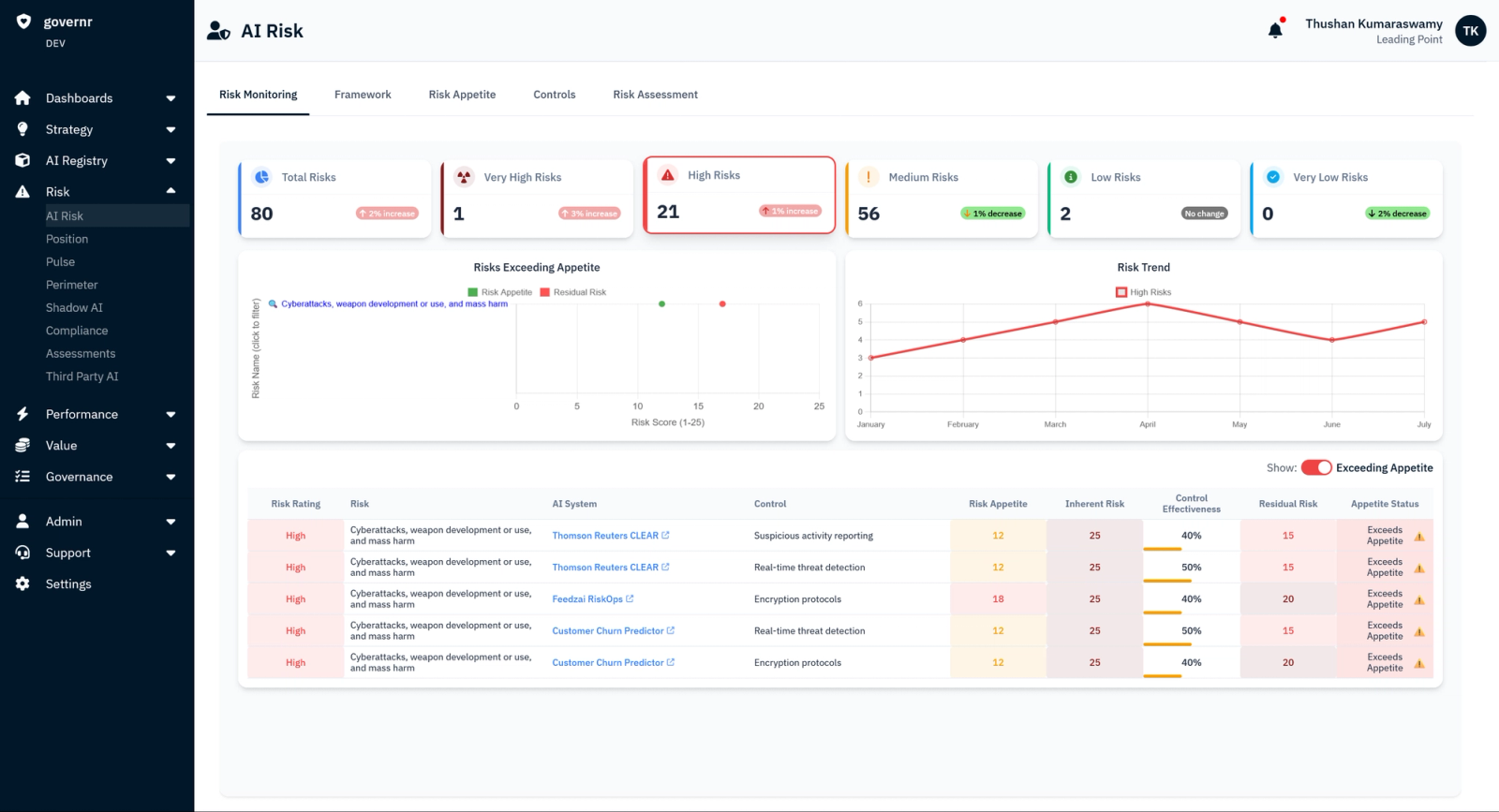
And increasingly, it means monitoring. AI systems change too quickly for static governance to hold up on its own.
This is the real shift. AI control cannot just be an extension of traditional IT review. It has to reflect the properties of the systems being governed.
Why this matters more in regulated environments
This distinction matters everywhere, but it matters most in regulated sectors.
In banking, healthcare, insurance, defence, and critical infrastructure, the issue is not simply whether AI creates innovation. It is whether organisations can show that AI is being deployed with clear ownership, bounded authority, evidence-backed control, and a credible response when conditions change.
That is harder to do when AI is hidden inside existing systems, procured through vendors, adopted informally by business teams, or allowed to evolve faster than the governance process around it.
The firms that get caught out will not necessarily be the reckless ones. They will often be the firms that believed their existing technology controls were enough.
Final thought
Firms do not lose control of AI because they lack policies.
They lose control because they treat a new kind of system as if it were an old one.
That is the real mistake behind the phrase "AI is just another technology risk."
It is not.
And the earlier firms recognise that, the better their chances of building control that is real rather than performative.
Ready to take control of your AI risk?
Get in touch to see how governr can help you inventory, assess, and monitor all your AI systems.